Three terms, one industry. What each one actually means
If you’ve spent any time researching delivery-only food operations, you’ve seen all three terms used for the same thing. Sometimes in the same article. Ghost kitchen, dark kitchen, cloud kitchen. They often mean the same thing. But they came from different places, carry different associations, and the platforms that built this industry use none of them.
This piece traces where each term came from, how operators and platforms use them today, and which one most accurately describes what the Dish’d franchise actually is. If you’re trying to get your bearings in this sector before committing to a model, start here.
Three terms, and why none of them agree
The delivery kitchen industry scaled faster than its vocabulary did. By the time investors, operators, trade journalists, and platform teams were all talking about the same thing, each group had already settled on a different name for it.
The confusion follows geography. In the United States, ghost kitchen is standard. In the UK, most trade press and franchise literature says dark kitchen. In India, Southeast Asia, and the Middle East, cloud kitchen dominates. None of these groups deferred to each other, so all three are still in active use.
The platforms themselves make things worse. Deliveroo, the operator behind the UK’s largest delivery-only kitchen programme, uses neither ghost kitchen nor dark kitchen in its partner-facing language. Their Editions page reads: “Expand into new locations with our delivery-only kitchens.” (Deliveroo Editions page, verified April 2026.) Uber Eats reportedly uses “virtual restaurant” in partner documentation, though this couldn’t be independently verified from public pages. Just Eat has no distinct programme and no dedicated term.
So: operators say “dark kitchen,” Americans say “ghost kitchen,” the Asian market says “cloud kitchen,” and the platforms say something else entirely.
Ghost kitchen: the US original
Where the term came from
Ghost kitchen emerged in Los Angeles and New York from roughly 2013 to 2015, as the first wave of delivery-only operations appeared in cities where high rents made traditional restaurant economics unworkable. It spread through trade coverage before crossing into the mainstream press.
By 2018 it was appearing in Hollywood trade publications. A 2019 New York Times article used it in quotation marks, a reliable signal that the term was still novel enough to flag for a general reader. That caution has since gone. Merriam-Webster now carries a formal dictionary entry for “ghost kitchen,” which is about as clear a signal as you get that a term has gone mainstream in North American English.
Today it is the dominant term in US trade press and VC conversations. If you’re reading a pitch deck from an American fund or a piece by a US food tech journalist, ghost kitchen is what you’ll see.
What ghost kitchen actually describes
The ghost kitchen concept is straightforward at the operational level: a kitchen producing food exclusively for delivery. No dine-in, no walk-in counter. The customer never sees the place. Running a ghost kitchen business means operating entirely on delivery platform revenue, with no front-of-house income to fall back on.
What makes the term messy is that it gets used for two quite different things: purpose-built delivery kitchen facilities, and virtual brands running from the back of an existing restaurant. The second category is far more common and far harder to count.
By some estimates, the UK had under 1,000 dark or ghost kitchen operations before the pandemic, based on an approximate Statista baseline of around 750 in 2020. Current aggregator estimates put the figure at 5,500 or more operations by 2024-2025. That almost certainly includes virtual brands running from existing restaurant kitchens alongside standalone purpose-built facilities. If you count every existing kitchen running a virtual brand on a delivery app, the number grows quickly and the pre-pandemic comparison becomes hard to interpret. Treat 5,500 as a rough order of magnitude, not a precise count.
Dark kitchen: the UK version
Where the term came from
Before 2017, “dark kitchen” in UK newspaper databases meant something entirely literal: a poorly lit cooking space. The delivery-industry sense didn’t exist. What Americans were calling a ghost kitchen uk operators and journalists had no standard name for yet.
That changed from 2017, and the timing isn’t coincidental. In April 2017, Deliveroo launched Deliveroo Editions, the first major branded delivery-only kitchen rollout by a UK delivery platform. Deliveroo built purpose-built kitchen sites across UK cities, rented space within them to restaurant partners, and handled logistics. The press coverage of that launch helped establish “dark kitchen” as the standard descriptor in UK trade media.
That origin has shaped the term’s connotations. Understanding the dark kitchen meaning in a UK context means separating the purpose-built facility model from virtual brands running out of existing kitchens. When a UK trade journalist writes “dark kitchen,” they’re typically referring to a dedicated space, not a pizza restaurant running a wing brand from its existing oven.
How UK operators and platforms use it today
Dark kitchen is still the standard term in UK trade journalism, franchise literature, and industry reports. It’s what most operators in this country will say when asked what they run.
The irony is that the platforms which built the UK dark kitchen industry don’t use the term publicly. Deliveroo says “delivery-only kitchens” and “Editions.” Uber Eats reportedly says “virtual restaurant.” Just Eat has no programme and no term.
Deliveroo Editions is worth understanding in some detail because it represents one specific model for how this can work. Deliveroo operates 20+ Editions sites across the UK (Deliveroo Editions page, confirmed April 2026). Orders from Editions sites average five minutes faster than from brick-and-mortar restaurants. Late orders and missing items occur at roughly one third the rate of non-Editions sites (Deliveroo internal data, 2023; EHO ratings data January-July 2024).
Deliveroo describes Editions as “a turnkey solution to expansion. Test your brand in new locations without the need to invest in a brick-and-mortar site.” (Deliveroo Editions page.)
Zan Kaufman of Bleecker Burger, a partner operator, is more direct: “The Editions teams are true professionals. The process from getting a site to opening was so streamlined. We’ve never had such a stress free opening…and in the middle of a pandemic we were able to grow our business, thanks to Editions.” (Deliveroo Editions page.)
Not everyone has been positive about the economics of platform-operated delivery kitchens. The margins are tighter than they look on paper, and the model you choose matters as much as the market you enter.
Cloud kitchen: the Asian market term
Where it came from and where it is used
Cloud kitchen is the standard term in India, Southeast Asia, and the Middle East. The cloud kitchen concept differs in its associations from ghost and dark kitchen. Where the US and UK terms describe the absence of dine-in, cloud kitchen more specifically refers to aggregator-backed or platform-operated kitchen networks, where the technology layer is central to how the operation functions.
Rebel Foods, originally known as Faasos, is one of the early pioneers of this model at scale in India. Founded in Pune, they built a network of delivery-only kitchens and used shared infrastructure to run multiple food brands from a single site. The approach became a widely-cited template for the cloud kitchen model across the Asian market.
Travis Kalanick’s CloudKitchens, which he took control of in 2018, gave the cloud kitchen concept significant global VC exposure. The company raised substantial funds and expanded into multiple markets including the UK. Despite that, “cloud kitchen” hasn’t become a standard term in UK operator conversation. You’ll find it in investor decks and startup coverage. You’ll rarely hear a UK kitchen operator use it to describe their own business.
The market figures are substantial. The European market for these operations was estimated at USD $6.21 billion in 2025, forecast to reach USD $20.98 billion by 2032 at a 19% compound annual growth rate (Coherent Market Insights; forecast, not actuals). Globally, the market was estimated at USD $108.8 billion in 2024, projected to grow to USD $230 billion by 2033 at a 7.6% CAGR (Credence Research; forecast, not actuals). These figures span all three terminology camps: purpose-built facilities, virtual brands from existing kitchens, and platform-operated networks.
So what is the actual difference?
Not much, operationally. The ghost kitchen concept, the dark kitchen concept, the dark kitchen meaning in the UK sense, and the cloud kitchen concept all describe a kitchen producing food for delivery with no dine-in component. The differences are geographic and associative, not structural.
The table below maps how each term is actually used.
| Term | Origin | Dominant geography | Who uses it | Typical meaning |
|---|---|---|---|---|
| Ghost kitchen | US, c.2013–2015 | North America | Trade press, VCs, general media | Delivery-only kitchen; used loosely for purpose-built facilities and virtual brands from existing kitchens |
| Dark kitchen | UK, from 2017 | UK and Europe | UK trade press, franchise industry, operators | Same as above, with stronger association with purpose-built facilities |
| Cloud kitchen | Asia, from c.2015 | India, SE Asia, Middle East | Investors, tech-adjacent startups | Aggregator-backed or platform-operated kitchen networks |
| Delivery-only kitchen | UK (Deliveroo’s term) | UK, Deliveroo ecosystem | Deliveroo partner pages | Deliveroo Editions model specifically |
| Virtual restaurant | US/UK | Both | Uber Eats partner docs, some operators | A delivery brand running from an existing kitchen with no dedicated facility |
The “virtual restaurant” entry is closest to what most people running virtual brands are actually doing. They’re not building a new facility. They’re running a delivery brand from a kitchen they already have.
The practical rule: use the term your audience recognises. For UK operators and franchise partners, dark kitchen is the right register. For US investors or anyone comparing UK and US operations, ghost kitchen is what they will expect. Note that the ghost kitchen UK operators encounter is almost always called a dark kitchen locally, even if the underlying model is identical. For anything involving Deliveroo directly, their own term, delivery-only kitchen, is the one to use.
Where does Dish’d fit?
Dish’d is a virtual brand franchisor. That puts it in a separate category from everything else described in this article.
Dish’d doesn’t own or operate kitchen sites. It’s not Deliveroo Editions, which requires cooking in a space Deliveroo controls. Dish’d partners bring their own existing commercial kitchen. Dish’d supplies the brands, tested recipes, kitchen training, marketing assets, and ongoing support. The partner lists on Deliveroo, Uber Eats, and Just Eat. No new premises needed.
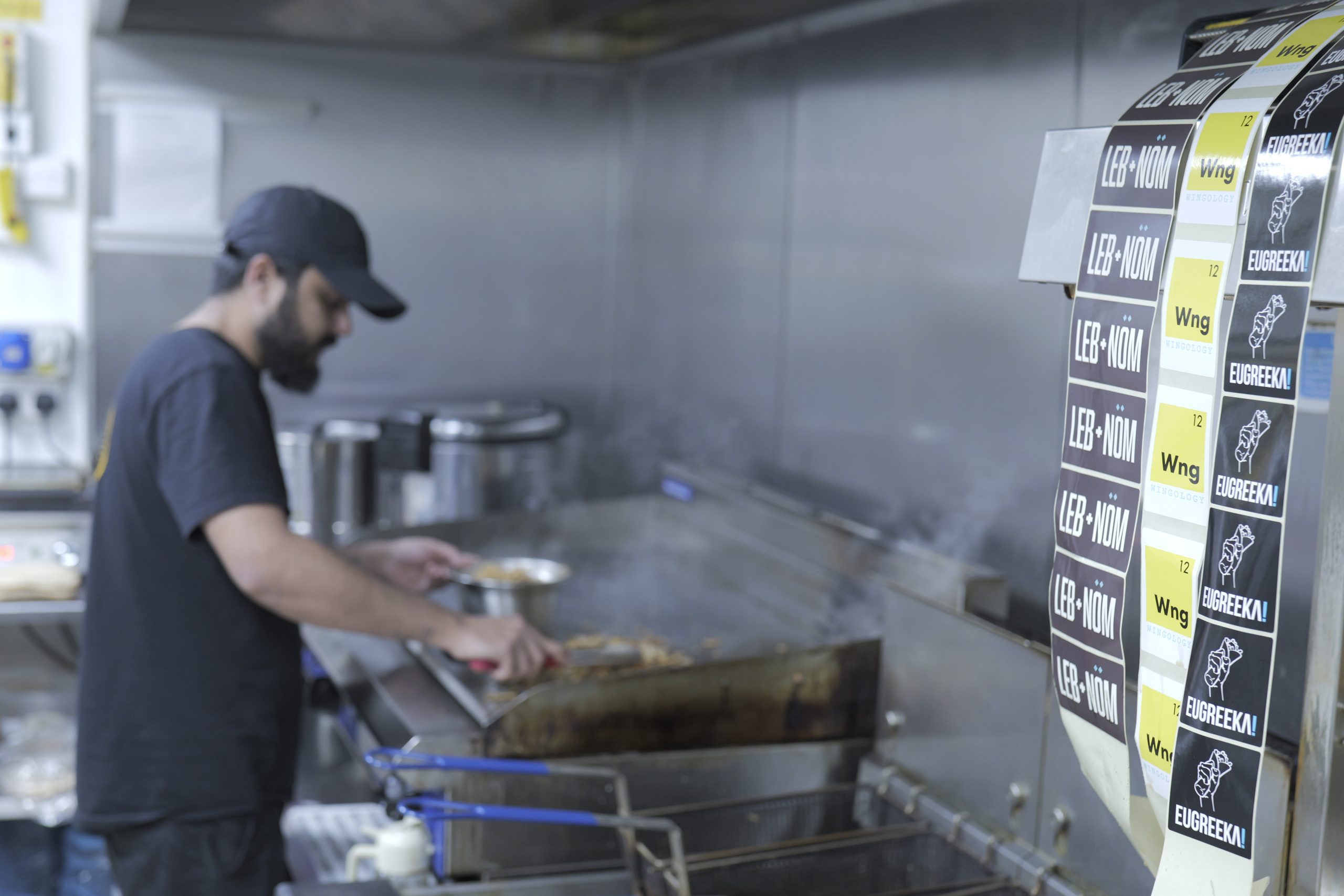
The four proprietary brands are Wingology (fried chicken), Eugreeka! (Greek), Bao + Bowls (Asian), and Leb + Nom (Middle Eastern). Total franchise investment runs from £10,000 to £20,000, with a franchise fee of £3,500. Dish’d has 70+ partner kitchens and celebrated its 50th franchise opening in April 2025. The company was recognised among the UK’s Top 50 fastest-growing food and drink franchise brands by What Franchise magazine (Issue 20.3, June 2025).
None of that makes Dish’d right for every operator. Delivery kitchen economics depend entirely on which model you pick and how well you execute it. An existing kitchen with capacity to absorb virtual brand orders during off-peak hours is a fundamentally different proposition from taking on a lease for a standalone dark kitchen facility. The capital exposure, risk profile, and margin structure are different in each case.
Dish’d’s model is built for the first type of operator. If your kitchen has idle capacity and you’re already on the delivery platforms, the marginal cost of adding a virtual brand is low. If you’re building a dark kitchen from scratch, that’s a different conversation.
Why the naming confusion actually matters for operators
This isn’t a semantics argument. The terminology you use in dealings with your local planning authority, your environmental health officer, and your delivery platform account manager has real consequences.
Planning use class. Class A3 (restaurants and cafes) was abolished on 1 September 2020 and replaced by Class E, covering Commercial, Business and Service uses where customers visit the premises to consume food (Planning Portal, verified). A delivery-only kitchen with no customer access doesn’t fit neatly into Class E. It’s more likely classified as Sui Generis, sitting outside all named use classes and requiring specific planning permission (Planning Portal, verified). Converting an existing restaurant to delivery-only use, or opening a kitchen solely for delivery, almost certainly needs a formal change of use application. Get pre-application advice from your local planning authority before committing to a site.
Food business registration. Every business that sells, cooks, stores, handles, prepares, or distributes food, including delivery-only and online operations, must register with their local authority at least 28 days before trading (GOV.UK, published 31 August 2023). Registration is free. Each location registers separately. The trading name on the registration must match the name on the delivery platforms.
FSA rating. Deliveroo requires a minimum Food Standards Agency rating of 2 out of 5 to appear on the platform (Deliveroo, verified). This is a hard gate. A rating below 2 and the listing can’t go live, regardless of anything else.
Food safety systems. Food hygiene certificates are not a legal requirement (FSA, verified January 2025). What is legally required is a HACCP-based food safety management system for all food businesses (FSA, verified January 2025). In practice, environmental health officers inspecting delivery kitchens typically expect staff to hold at least a Level 2 Award in Food Safety, though this isn’t formally codified in regulation.
Ghost kitchen, dark kitchen, cloud kitchen: the label doesn’t affect any of the above. Whether you are setting up a ghost kitchen business in London or a dark kitchen concept in Manchester, the regulatory framework is the same regardless of what you call the operation.
The short version
For readers who scrolled straight here.
Ghost kitchen is the American term for a delivery-only kitchen. It emerged in Los Angeles and New York around 2013 to 2015 and is now in the dictionary.
Dark kitchen is the UK term for the same thing. The dark kitchen meaning came into widespread use from 2017, roughly when Deliveroo launched Editions and the trade press needed a name for what they were describing.
Cloud kitchen is the Asian market term, used most commonly in India, Southeast Asia, and the Middle East. It refers to aggregator-backed or platform-operated kitchen networks, and it gained global VC exposure through Travis Kalanick’s CloudKitchens business.
All three describe similar operations. The compliance requirements in the UK are identical regardless of which label you use.
Dish’d fits none of these categories exactly. It’s a virtual brand franchise: partners use their existing commercial kitchen to run Dish’d brands on the delivery apps, with Dish’d providing the brand, recipes, training, and support.