Dark kitchens are sold as passive income. Add a delivery-only brand to your existing kitchen, catch orders while your main operation ticks over, and earn revenue you would not otherwise see. Most operators who tried this in 2024 found it is more demanding than advertised: compliance steps they had not anticipated, a 30-day window on their first delivery platform that most of them wasted, and margin calculations that only work if you get a few things right before day one.
The UK delivery market is now worth over £14 billion and still growing (Lumina Intelligence). The demand is there. But 90-day failures are common, and they are almost always the result of pre-launch decisions, not the concept itself.
If you already run a food business and you are thinking about setting up a dark kitchen alongside your current operation, this is the list to work through before you go live. Compliance, premises, equipment, insurance, platform onboarding, and the tactical decisions that determine whether your first 30 days build momentum or waste it.
What “starting a dark kitchen” actually means for an existing operator
The terminology varies by geography and platform. The UK trade press uses “dark kitchen.” Deliveroo’s own partner-facing documentation uses “delivery-only kitchen” exclusively. In the US, “ghost kitchen” is the standard term. All three refer to the same model: food prepared for delivery with no dine-in element. Whether you call it starting a ghost kitchen or starting a dark kitchen, the compliance requirements, platform mechanics, and setup decisions are the same.
For an existing operator, there are two entry routes, and the setup requirements for each differ considerably.
The first is adding a delivery only kitchen brand to your existing commercial kitchen. You use the space and equipment you already have, create a separate brand listing on a delivery platform, and run it alongside your current operation. The marginal investment is modest. The compliance requirements, however, largely repeat. This route suits operators who want to open a ghost kitchen operation without taking on new premises or a full fit-out.
The second is renting a dedicated dark kitchen space. New premises, a full fit-out, and separate registration and inspection processes from scratch.
There are now 5,500+ dark kitchen operations running in the UK, up from under 1,000 before the pandemic (aggregator data, treat with caution as definitions vary widely). Local saturation for a given cuisine type is a real factor in your early order volume. Worth understanding before you decide which route to take.
What virtual brands are and how they work
The legal and compliance checklist
Most operators underestimate the compliance side because they already have food hygiene covered for their main business. Adding a delivery-only arm means repeating parts of this process, and skipping steps here is the most common cause of pre-launch delays.
Food business registration
Every separate trading location must register with the local authority at least 28 days before trading, and this includes delivery only kitchen operations. Registration is free via GOV.UK (GOV.UK, 31 August 2023).
If you are launching a virtual brand from an existing kitchen, that brand name must be linked to a registered premises with a paper trail for Environmental Health Officer (EHO) inspection. The brand is not a separate entity, but the local authority needs to know it is operating from your address, and the documentation needs to match (Infinitas Food Safety, 2025).
Food hygiene certificates and HACCP
Food handlers are not legally required to hold a food hygiene certificate, but HACCP-based food safety systems are a legal requirement for all food businesses (FSA, January 2025). The practical EHO expectation at inspection is Level 2 Award in Food Safety for food handlers and Level 3 for supervisors.
The most commonly reported pre-launch compliance mistake is registering with the council before HACCP documentation is complete. Registration triggers the inspection clock. Get your paperwork in order first, then register (Infinitas Food Safety).
FSA hygiene rating and platform access
Deliveroo requires a minimum FSA hygiene rating of 2 to be listed on the platform. This is a hard gate. Below 2 means removal, not reduced visibility.
Inspectors assess three things: how food is handled, the physical condition of the premises, and your food safety management systems. Inspection frequency runs from every six months for high-risk businesses to up to every two years for low-risk operations (FSA, March 2024).
Display of your hygiene rating sticker is mandatory in Wales and Northern Ireland and voluntary in England. Either way, platforms can see the rating, and Deliveroo will enforce its minimum regardless of where you are based.
Planning permission and premises requirements
This is the section most operators skip and most often regret.
The old Class A3 planning use (restaurants and cafes) was abolished on 1 September 2020 and replaced by Class E, which covers commercial premises where customers visit. A dark kitchen restaurant conversion or new dark kitchen space with no customer access does not fit Class E. It is likely to be classified as Sui Generis, meaning it sits outside all named use classes and requires specific planning permission. Converting a commercial space to delivery-only use may require a change of use application (Planning Portal).
Before committing to any new or converted site, get pre-application advice from your local planning authority. Some LPAs have taken a more permissive view of a delivery only kitchen as incidental commercial use, but this is not uniform across England.
Environmental health friction points are also worth knowing in advance. Extraction must exhaust outside in compliance with Building Regulations Parts F and J. Odour filtration is required in residential or mixed-use areas. Waste must be secured and collected by a licensed carrier. EHOs can serve abatement notices under the Environmental Protection Act 1990 for noise and odour issues (general EH framework; specific requirements vary by LPA).
For operators adding a virtual brand to an existing licensed kitchen where planning use and ventilation are already compliant, this section is lower risk. The planning question primarily affects operators taking on new or converted spaces.
How Dish’d assesses partner kitchens before launch
Equipment: what you actually need
The figure most commonly cited for fitting out a dark kitchen from scratch runs £69,000-£140,000 (3S POS). That covers premises fit-out, technology, and working capital reserve, and it is not what most existing operators are facing.
If you are adding a delivery-only concept to an existing commercial kitchen, the marginal equipment investment is typically £3,000-£6,000, usually a griddle and fryer addition to what you already have.
If you are fitting out a rented dark kitchen space from scratch, the realistic budget for core equipment is £5,300-£15,100, plus £2,000-£2,485 per month in ongoing rent and utilities (StartupMag UK, South East London operator case study).
Core equipment cost ranges for a rented space fit-out:
| Item | Low | High |
|---|---|---|
| Commercial griddle | £400 | £1,500 |
| Freestanding fryer (single tank) | £600 | £2,000 |
| Extraction hood | £800 | £3,000 |
| Under-counter fridge | £400 | £1,000 |
| Upright fridge | £800 | £1,500 |
| Prep surfaces and sinks | £800 | £2,200 |
| Installation (gas, electric, extraction) | £1,000 | £3,000 |
| Small equipment (pans, utensils) | £500 | – |
| Total | £5,300 | £15,100 |
How Dish’d assesses partner kitchens before launch
Insurance: what is legally required and what is expected
Employers’ Liability Insurance is legally required if you employ staff, with a minimum cover of £5 million. Public Liability and Product Liability Insurance are not legally required but are expected by delivery platforms and landlords. Without them, platform approval is unlikely in practice.
Budget £400-£1,100 per year to cover all three policies for a typical ghost kitchen business or dark kitchen operation (SimplyQuote, Simply Business). Entry-level fast food delivery insurance is available from £6.62 per month, with a full package typically running £500-£1,200 per year.
These figures cover the kitchen operation only. They do not include vehicle or hire-and-reward insurance for in-house delivery drivers, which adds a separate cost if you are not using platform couriers.
Getting onto the platforms
Deliveroo
Deliveroo’s onboarding process takes “as little as 7 days.” The onboarding fee is £510 inc. VAT, payable in eight instalments of £63.75.
Commission is industry-reported at 30-35% for standard delivery. Deliveroo does not publish its commission rates publicly, so you will need to confirm the specific rate for your account when you apply. For Editions (Deliveroo-operated kitchen sites), commission reportedly runs up to 35%.
A minimum FSA rating of 2 is required to appear on the platform. Food photography must be uploaded before going live. This is not optional.
After your first 30 days, your position in the app is governed by Deliveroo’s Value Programme. Your monthly Value Score is calculated across three areas: price parity with your dine-in menu, service quality (prep times, order accuracy, cancellation rate), and customer rating. Strong scores unlock additional visibility features including Deliveroo’s Choice badge and funded promotional slots. Poor scores reduce your visibility, and persistent poor performance risks suspension (Deliveroo Partner Hub).
Uber Eats
Standard commission on Uber Eats is reported at up to 35% depending on the agreement. If you operate your own delivery courier, the reported rate drops to 13%. Uber Eats does not publish its UK rate card publicly, so contact them directly for current terms.
At these commission levels, margin management from day one is not optional. There is no point building order volume at a rate that does not cover costs.
Just Eat
Just Eat charges 14% plus VAT plus £0.50 per order, with a £295 setup fee. There is no equivalent to Deliveroo Editions. Just Eat accepts delivery only kitchen operators as standard listings.
How Dish’d manages multi-platform launch
The 30-day window that defines your first year
This is the most operationally important section in this article.
When a new restaurant goes live on Deliveroo, it receives a 30-day boost in the app’s restaurant list. After that window closes, ranking depends on the same factors as every other listing: order history, customer ratings, prep speed, and acceptance rate.
After the boost expires, ranking is determined by customer rating, Estimated Order Duration (prep speed), order acceptance rate, conversion rate, past order volume, and direct brand searches. Every one of these factors rewards established listings over new ones.
This creates a problem. The algorithm rewards order history, but you have none when you launch. The 30-day boost is the only free visibility window you will ever get for that listing. Operators who list and wait during this period are wasting the highest-leverage time in their platform lifecycle.
What needs to be ready before you go live:
Food photography for every menu item. Menus with photos generate 24-25% more orders (Deliveroo). This is the highest-ROI action available at launch. Upload before you go live, not after.
Promotional offers active from day one. Percentage discounts, free delivery, and spend-and-save thresholds all drive new customer acquisition. Use minimum spend thresholds to protect your margin. Operators who offer discounts without a minimum spend floor frequently burn working capital in the first few weeks.
Sponsored listings running from day one. Deliveroo’s Marketer Adverts run on a CPC model from 25p per click. Running paid ads during the organic boost period compounds the effect. Sponsored listings deliver up to 14% weekly sales increase when combined with the organic boost (Deliveroo internal data).
Auto-acceptance enabled. Deliveroo reports that rejection rates fall by over 11% for restaurants using auto-acceptance (Deliveroo, not independently verifiable from public pages). Rejected orders hurt both your ranking and your customer ratings.
At least 20 positive reviews within the first 30 days. Review volume affects post-boost ranking. The specific threshold is not confirmed by Deliveroo, but this is an operator-cited benchmark that appears consistently in UK delivery operator forums.
On revenue, the range is wide. A Northwest London operator reported averaging £3,500-£4,000 per week across approximately 200 Deliveroo orders (UK Business Forums). A Manchester-area dark kitchen food delivery operation reported £10,000 per month at a single location (StartupMag UK). These figures are from individual operators and should not be treated as averages, but they illustrate what is achievable with active management during the launch phase.
Dish’d partners get a structured six-day launch training programme and a dedicated operations manager focused on maximising the 30-day window. How the Dish’d franchise launch works
The first 90 days: mistakes that kill new dark kitchens
What follows is not hypothetical. These are documented recurring patterns from operator forums and industry research.
Registering before HACCP documentation is complete. Registration triggers your inspection clock. If your food safety management systems are not documented and ready, you are running against a deadline you are not prepared for. Get the paperwork finished first (Infinitas Food Safety).
Launching without food photography. The 24-25% order uplift from photos (Deliveroo) is the most reliably documented performance gain available at launch. Operators who go live without photos give away volume during the boost period. That volume does not come back.
Underpricing to attract early orders. Losing margin without compensating volume burns working capital. The instinct to price low to generate reviews is understandable, but it frequently accelerates cash burn without producing the review velocity operators expect. Use promotions with minimum spend thresholds instead.
Ignoring prep time. Estimated Order Duration is a direct ranking factor on Deliveroo. Slow prep tanks visibility. A well-documented London dark kitchen case study reported a 10-minute completion window per order as the performance standard (eCommerce Basis, April 2024). If your current kitchen processes cannot support that for a delivery concept, the concept needs redesigning before launch, not after.
Operating outside registered trading hours. This attracts enforcement and directly hurts platform rankings. Both problems are avoidable.
Underestimating working capital. Most operators setting up a dark kitchen need a 3-6 month working capital buffer before reaching consistent profitability. If monthly revenue stays below £5,000, capital burns. Based on aggregated operator data, profitability is typically reached between months 6-12, though no single published primary source confirms this as a universal benchmark. Operators who launch without a sufficient buffer frequently close during this window, not because the model does not work, but because they ran out of runway before it did.
The economics are not always straightforward. Margin pressure in delivery kitchen operations has been well documented since the model first scaled in the UK, and the caution is still relevant. The opportunity is real; it is not automatic.
How a virtual brand franchise changes the setup equation
Everything above still applies. The compliance requirements, the planning considerations, the 30-day window mechanics, the working capital calculation. A franchise does not make those go away. What it does is handle the layer of decisions that takes most independent operators 3-6 months to work through themselves: tested recipes, menu photography, platform listings already structured for conversion, training on prep standards and timing, ongoing operational support.
Setting up a dark kitchen or setting up a ghost kitchen as part of an existing operation is manageable, but the things new operators most commonly get wrong in the first 90 days are exactly what a franchise is designed to cover.
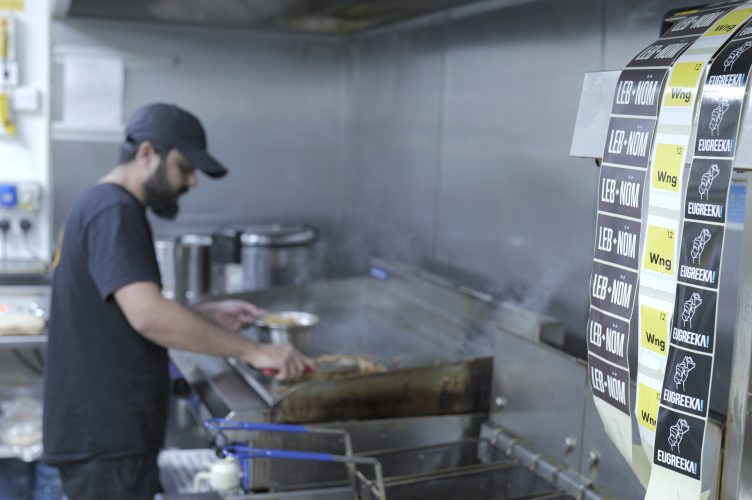
Dish’d is a UK virtual brand franchisor operating four proprietary brands: Wingology, Eugreeka!, Bao + Bowls, and Leb + Nom. Existing operators add Dish’d brands to their current commercial kitchen. A kitchen assessment confirms suitability before any investment is committed.
The financial figures Dish’d publishes are company-reported and have not been independently audited, but they are worth understanding as a benchmark. The company cites average weekly additional sales of £8,000, a weekly sales range of £8,859-£15,321, and a weekly profit range of £2,002-£3,462, with a food and packaging cost target of 25% of net sales. Total investment runs £10,000-£20,000 (What Franchise). One London-based Dish’d partner reported breaking £9,000 in additional weekly sales, with consistent 10% week-on-week growth.
All four Dish’d brands were named among What Franchise magazine’s Top 50 fastest-growing food and drink franchise brands in the UK (Issue 20.3, June 2025).
See the full Dish’d franchise package
Before you go live: the pre-launch checklist
Most of what determines whether a new dark kitchen business lasts its first year can be sorted out before launch.
Compliance first: food business registration at least 28 days before trading, HACCP documentation completed before you register (not after), FSA hygiene rating of 2 or above confirmed, and planning use verified for your specific premises. Registration is free. The delays caused by skipping steps are not.
Then infrastructure: equipment matched to your actual menu rather than a speculative fit-out, insurance covering employers’ liability, public liability, and product liability, platform accounts set up with commission rates confirmed in writing, and food photography ready before the listing goes live.
Then the launch: promotional offers active from day one with minimum spend thresholds protecting your margin, sponsored listings running from day one, auto-acceptance enabled, and a plan to get to 20 positive reviews inside the first 30 days. More importantly, someone actively working the operation during the boost period, not just watching it.
Operators who treat those first 30 days as a campaign outperform those who list and wait. The gap between a dark kitchen food delivery operation that reaches profitability at month six and one that runs out of cash at month three is almost always in the preparation.
Starting a dark kitchen through a franchise reduces the number of those calls you have to make yourself, for the first time, under pressure. If you are already running a commercial kitchen, that is where the model tends to make the most sense.
Already running a commercial kitchen? Dish’d can assess your setup and get your first brand live within four weeks. Apply for a Dish’d kitchen assessment